 Students are sent to school by their parents, basically, to be educated and to learn. Parents give their full trust and support to the educators and school staff to hone their child’s knowledge and skills to be able to go to a good, if not the best university and succeed later on in life.
As educators, we play a crucial role in shaping students’ mind. What we are cultivating now will be reaped in the future. It is a challenging role for us, however, are we certain that we are able to impart the knowledge and skills necessary for them to succeed in the future? Are we able to develop students, thus, reaching erudition to keep up with the changing world.
According to Charles Darwin’s theory of evolution by natural selection, organisms that possess heritable traits that enable them to better adapt to their environment compared with other members of their species will be more likely to survive, reproduce, and pass more of their genes on to the next generation (National Academy of Sciences, 2017). One of which trait that is critical to adapt and survive is – INTELLIGENCE.
John Locke conceptualized that the child’s mind is a blank tablet (tabula rasa) that gets shaped and formed by his/her own experiences. He believed the mind becomes what it experiences from the outside world. Considering the drastic changes in today’s world, we should ensure that students are adept to the needs of the 21st century. Educators need to prepare students, not only mastering the core of subjects, but also cultivate flexibility and learning quickly with the aid of technology. Communication, collaboration and creativity are the skills required in the knowledge-based industries of the future (Mubarak, 2014). NCREL suggests that educational decision makers need to acknowledge that the academics of yesterday are not sufficient for today.
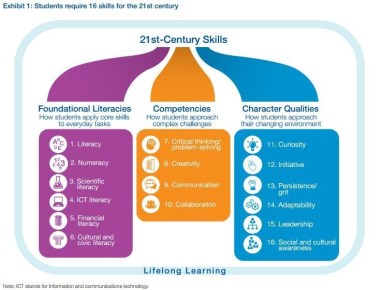 The Partnership for 21st Century Skills lists three types of skills essential for 21st Century Learners: Learning Skills: Critical Thinking, Creative Thinking, Collaborating, Communicating; Literacy Skills: Information Literacy, Media Literacy, Technology Literacy and Life Skills: Flexibility, Initiative, Social Skills, Productivity, Leadership. Success in developing these skills can be attained if we develop students’ intelligences as described by Gardner in his Theory of Multiple Intelligences. Take for instance, linguistic and interpersonal intelligences. A student may develop collaborative and communication skills if he has a good linguistic and interpersonal intelligences. Being able to use words effectively and convey it through communication makes a student more adept and increase chances of surviving the competitive market.
In this case, educators need to incorporate activities that will ensure enhancement of intelligences through various activities, such as peer sharing and role-playing. A 70-country study by the McKinsey Global Institute estimates that by 2020, approximately 83 million high- and middle-skilled jobs will go unfilled because employers looking to hire in developed and developing countries will not find people with the necessary skills. Therefore, educators need to keep in mind the various intelligences that should be molded to reflect on the skills needed.
Learning abilities varies from student to student. A student may perform well in academic subjects, such as Science and Math, but may not be in other facets of education like Physical Education or Music. This contradicts Spearman’s General Intelligence or the Factor Analysis. He noted that while people certainly could and often did excel in certain areas, people who did well in one area tended also to do well in other areas. A wide array of evidence from research on development, education, neurology and genetics suggests that it is unlikely that a factor general to all abilities produces individual-differences in all of what are regarded as indicators of human intelligence. There have been many efforts to discredit and counteract this evidence: they have not altered the conclusion: no general factor has been found (Horn, 2006).
Educators are essential to enhance students’ intelligence. These intelligences can be developed, with consideration of the biological and neurological processes of one’s body and the effect of external environment. In order to keep up with the changing world, we, as educators have to rethink if we are equipping our students with the indispensable skills and promote 21st Century learning. We should have profound knowledge of the theories underlying learning and intelligence to dwell accordingly with our role in Education. As educators, we should develop ourselves and keep updated with the latest trends in teaching and learning, lest, be left behind with the world and not survive.
References:
Cherry. (2017). What is general intelligence? Retrieved from https://www.verywell.com/what-is-general-intelligence-2795210
Cherry. (2016). What are the different theories of Intelligence? Retrieved from https://www.verywell.com/theories-of-intelligence-2795035
Hammond, Austin, Orcott and Rosso. (2001). How people learn: Introduction to Learning Theories Retrieved from http://web.stanford.edu/class/ed269/hplintrochapter.pdf
Thoughtful Learning. (n.d.) What are 21st Century Skills? Retrieved from https://k12.thoughtfullearning.com/FAQ/what-are-21st-century-skills
Soffel. (10 Mar 2016). What are the 21st-century skills every student needs? Retrieved from https://www.weforum.org/agenda/2016/03/21st-century-skills-future-jobs-students/
Pacific Policy Research Center. 2010. 21st Century Skills for Students and Teachers. Honolulu: Kamehameha Schools, Research & Evaluation Division.
Mubarak. (2014). Education system needs to adapt to a fast-changing world. Retrieved from http://www.thenational.ae/thenationalconversation/comment/education-system-needs-to-adapt-to-a-fast-changing-world
U.S. National Academy of Sciences.(n.d.). Definitions of Evolutionary Terms. Retrieved from http://www.nas.edu/evolution/Definitions.html
McGinvey & Winthrop. (12 Sept 2016). Rethinking education in a changing world. Retrieved from https://www.brookings.edu/blog/education-plus-development/2016/09/12/rethinking-education-in-a-changing-world/
Horn. (4/3/2006). Understanding Human Intelligence: Where Have We Come Since Spearman? Retrieved from http://www.iapsych.com/articles/Horn2006b.pdf
 MITCHEL AFRICA