
After reading on some of the problems and issues in the Philippine Educational System, it keeps me wondering, “What really causes poor quality of graduates in our country? Or do we really produce poor quality graduates as what some literatures are claiming?”
I researched some factors that shows the status of the Educational system in the Philippines compared to other countries and some variables that might have a direct or indirect effect on it.
Literacy Rate. This is the percentage of people who can, with understanding, both read and write a short, simple statement about their everyday life. From 2010 to 2015, the Philippines increased its literacy rate from 95.81% to 96.62%. This is not relatively low compared to Singapore, which increases also from 95.86% to 96.77% also. However this is low compared to South Korea, which is consistent with 100%. (Data from World Development Indicator by World Bank)
Unemployment. The percent of unemployment in the Philippines decreases marginally from 2010’s 7.3% to 2014’s 7.1%. Indonesia’s unemployment rate declined from 7.1% to 6.2%. South Korea and Singapore both had a low unemployment rate since 2010, which is 4 and 3 percent respectively.
GDP. South Korea has a GDP of 1.4 trillions while Indonesia and Singapore has 888.1 Billions and 307.9 Billions respectively. Philippines is among the low income generating countries in Asia with 284.8 Billions.
Top Countries for Education. According to U.S. News, Singapore ranked top 15 and Korea got the 23rd spot. Indonesia and Philippines is among the low performing countries in education at 39th and 43rd. Scandinavian nations are ranked on top. This ranking is based from the status of public education and considering attending university in the particular country. Recently, in a study conducted by the World Top 20 Project, they listed South Korea and Singapore among the 2017 World’s Top 20 Education Poll Ranking Predictions. South Korea is on 3rd while Singapore is same on the 15th spot. Most Scandinavian countries are still on top with Finland on top.
Corruption Index. The corruption perception index shows Denmark, Finland and Sweden has been consistent among the top countries with less corruption. In 2016, Denmark ranked 1st and Finland and Sweden on 3rd and 4th. Singapore is top among the Asian countries and 7th in the world. South Korea decreased its ranking from 38th in 2015 and 52 in 2016. Philippines has been consistent among the most corrupt countries from 2015’s 99th and 2016’s 101th. Indonesia is also among the corrupt countries at rank 90.
Out of School Children. Philippines’ out of school youth decreased from around 900,000 in 2010 to 400,000 in 2012. Indonesia’s number of out of school children increases from 1.8 million to 2 million from 2013 to 2014. South Korea and Singapore have very less out of school youth.
Budget for Education. Scandinavian nations, such as Denmark, Norway, Sweden and Finland ranked in the top quarter, generally outperforming Asian nations where students are pressured to perform well, according to U.S. News’ Best Countries for Education. The Organization for Economic Cooperation and Development has said that levels of education funding do not necessarily affect academic performance, however, these countries spend some of the most money on education as a percentage of their gross domestic product, according to the World Bank.


Philippines’ Budget for Education since 2010. From year 2010-2015 the education sector received the top budget from Aquino’s Administration. This is in accordance to his goal of Education for all children in his 10-point agenda in Education and in preparation for the 2016’s implementation of the K-12 program.
2010 – 185.5 Billion based from abs-cbnNEWS.com
2011 – 207 Billion (19% increase; 12.4 B for construction of buildings, 1.8 B for 32.3 million textbooks, 1.6 Billion for hiring additional 10,000 teachers, 8.6 Billion for scholarships, training grants and student loan programs) based from Official Gazette of the Republic of the Philippines
2012 – 238.8 Billion (15% increase; according to Education Secretary Armin Luistro this is in preparation for Philippine Educational System to roll out K-12 Program)
2013 – 292.7 Billion (23% increase; to hire 61, 510 teachers; 31.1 Million textbooks and teachers’ manuals) from inquirer.net , some articles mentioned 293.3 Billion allocation for DepEd during this year
2014 – 309.43 Billion (14.4% increase; 44.6 Billion appropriation for construction, repair and rehabilitation of at least 43,000 Kindergarten, elementary and secondary school buildings nationwide; 8.56 Billion for 34,700 teaching and non-teaching position) based from Official Gazette of the Republic of the Philippines
2015 – 367.1 Billion (18.6% increase; 53.9 Billion for basic education facilities to cover the construction of 31, 728 classrooms, repair of 9500 classrooms; construction of 13, 586 water and sanitation facilities; 455 technical-vocational laboratories; 1.3 million seats; 10 Billion for 39,066 new teaching and 1,500 non-teaching positions; 3.5 Billion for 70.5 million textbooks and instructional materials to schools) based from Philstar Global and Official Gazette of the Republic of the Philippines
CONCLUSION:
As mentioned by U.S. News’ Best Countries for Education, those countries that allocated most of their budget to Education also have the best Educational System. I have not found a study to link this (let me know if there is), but I can see the relationship between the nation’s budget and academic performance. The richest countries in terms of GDP are those that are top performers in terms of education for years. Since 2010, the country had apportioned most of its budget to the education sector. So what could be the problem? This boils down to the most problematic issue in our country-CORRUPTION. The Philippines has been suffering from corrupt leaders for a very long period of time. The problem does not lie in the system of education. Whatever system or program is being implemented, if corruption keeps taking place, it will hinder its success.
But I should say, it is a strategic move for the reform of educational system in the Philippines in 2016. We have to welcome change considering that we are the only Asian country left with the old system.
Moreover, I do not think Philippines is producing low-quality graduates. Literacy rates show that we are not at par to other neighboring countries. I assume that the problem lies in underemployment because of lack of available jobs or some jobs are already filled with competent but not certified or qualified in the particular field. Some students are also forced to take courses, which are not of their choice or they are unaware of possible careers due to ineffective career orientation. This lies also to the problem of schools and universities. Our system is not training the students on the skills needed for the job available right now in the Philippines, rather, they are training students for jobs that are attractive abroad.
But still lots of questions are bugging me. The government has an increasing approximation of budget for education for years and the allocation for these budgets were overwhelming. But were these projects really done? Were the school facilities built as planned? Or are they still under constructions and remained unfinished? Were the job positions filled? Were the school materials bought?
I understand that corruption halts these but why can’t we work hand in hand to solve the problems? Why can’t we eliminate corruption and promote better education. I am still hoping and still dreaming-for an Education for a Globally Competitive Nation.
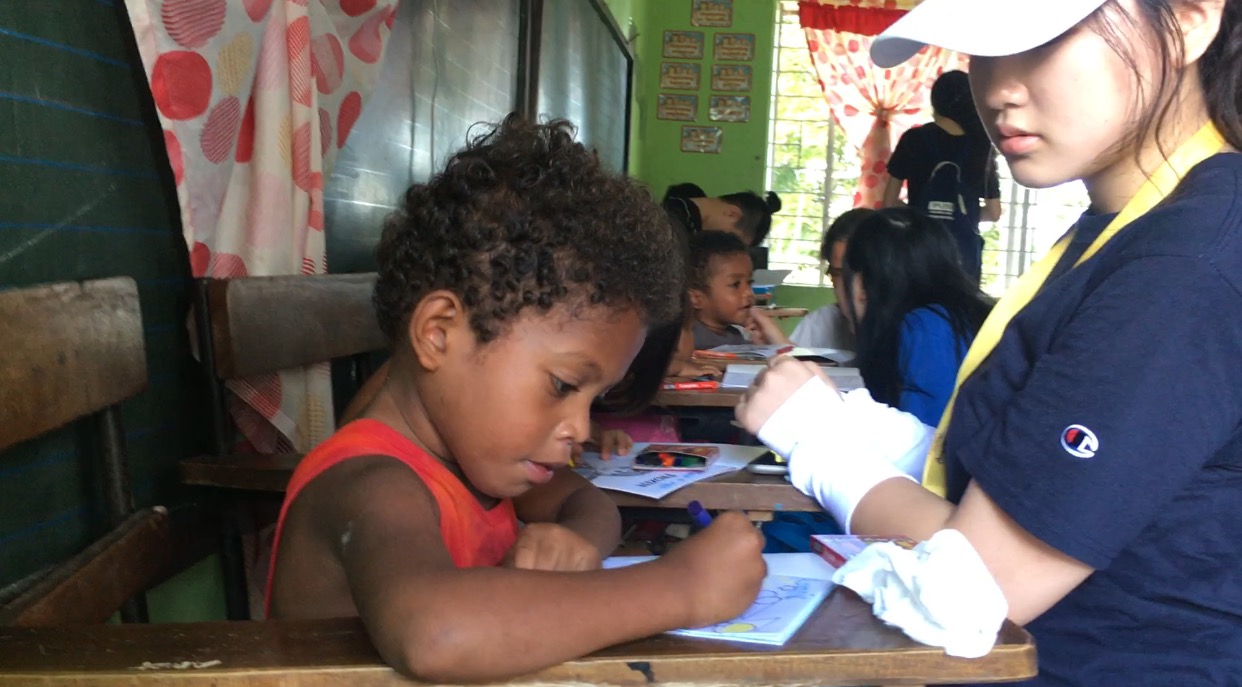
Images used in this post were taken during the MXIS students’ volunteering in a public school in the Philippines.
References:
Official Gazette of the Republic of the Philippines. Briefer on the President’s Budget Message for 2011.
Department of Education. DepEd Welcomes Budget Increase; Focuses on Universal Kindergarten. Press Release. January 3, 2011.
http://news.abs-cbn.com/business/12/18/09/philippine-congress-ratifies-p154-t-budget-2010
http://www.deped.gov.ph/orders/do-25-s-2010
http://www.gov.ph/2011/12/16/deped-gets-15-budget-increase-for-2012/
http://www.gov.ph/2014/01/27/education-gets-lions-share-of-2014-budget/
http://www.rappler.com/nation/34199-2014-budget-focus
http://www.rappler.com/nation/35186-deped-proposed-budget-biggest-in-history
http://www.gov.ph/2015/02/07/education-sector-to-get-a-bigger-boost-from-2015-national-budget/
http://www.rappler.com/nation/137492-look-back-aquino-10-point-education-agenda
http://www.gov.ph/aquino-administration/
http://worldtop20.org/worldbesteducationsystem?gclid=CMS90tGU_tMCFUtNfgodEaULng
https://www.transparency.org/news/feature/corruption_perceptions_index_2016
 MITCHEL AFRICA